исаакиевский собор на английском языке
Sacred Destinations
Sacred Sites, Religious Places, Pilgrimages
Russia
St. Petersburg
Related Books
St. Isaac’s Cathedral
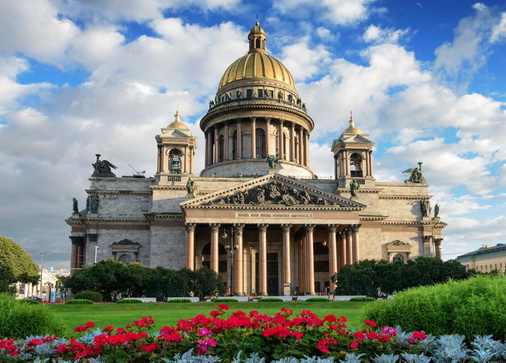
St. Isaac’s Cathedral is the largest cathedral in St. Petersburg. It was the largest church in Russia when it was built (101.5 meters high), and is still the third largest domed cathedral in the world. For visitors willing to climb 300 steps, it provides a spectacular view of St. Petersburg.
History of St. Isaac’s Cathedral
St. Isaac’s Cathedral was ordered by Tsar Alexander I to replace an earlier Rinaldiesque structure. A specially appointed commission examined several designs, including that of the French-born architect Auguste de Montferrand (1786-1858), who had studied in the atelier of Napoleon’s designer, Charles Percier.
Monferrand’s design was criticised by some members of the commission for the dry and allegedly boring rhythm of its four identical colonnades. It was also suggested that despite gigantic dimensions, the edifice would look squat and not very impressive. The emperor, who favoured the ponderous Empire style of architecture, had to step in and solve the dispute in Monferrand’s favour.
The cathedral took 40 years to construct, under Montferrand’s direction, from 1818 to 1858. It was dedicated to Saint Isaac of Dalmatia, a patron saint of Peter the Great.
Under the Soviet government, the building was abandoned, then turned into a museum of atheism. The dove sculpture was removed, and replaced by a Foucault pendulum.
During World War II, the dome was painted over in gray to avoid attracting attention from enemy aircraft.
Today, worship activity has resumed in the cathedral, but only in the left-hand side chapel, and in the main body of the cathedral on feast days only.
What to See
The severe neoclassical exterior of St. Isaac’s expresses the traditional Russian-Byzantine formula of a Greek-cross plan with a large central dome and four subsidiary domes. It is similar to Andrea Palladio’s Villa La Rotonda, with a full dome on a high drum substituted for the Villa’s low central saucer dome.
The exterior, which barely hints at the riotously rich interior, is faced with gray and pink stone, and features a total of 112 red granite columns with Corinthian capitals, each hewn and erected as a single block: 48 at ground level, 24 on the rotunda of the uppermost dome, 8 on each of four side domes, and 2 framing each of four windows.
The rotunda is encircled by a walkway accessible to tourists. 24 statues gaze down from the roof, and another 24 from the top of the rotunda.
The cathedral’s doors are covered in reliefs, patterned after the celebrated doors of the Battistero di San Giovanni in Florence, designed by Lorenzo Ghiberti.
Inside, suspended underneath the peak of the dome is a sculpted dove representing the Holy Spirit. Internal features such as columns, pilasters, floor, and statue of Montferrand are composed of multicolored granites and marbles gathered from all parts of Russia.
The iconostasis is framed by eight columns of semiprecious stone: six of malachite and two smaller ones of lazurite. The four pediments are also richly sculpted.
The interior was originally decorated with scores of paintings by the great Russian masters of the day. When these paintings began to deteriorate due to the cold, damp conditions inside the cathedral, Montferrand ordered them to be painstakingly reproduced as mosaics, a technique introduced in Russia by Mikhail Lomonosov. This work was never completed.
Quick Facts on St. Isaac’s Cathedral
| Site Information | |
| Names: | St. Isaac’s Cathedral |
|---|---|
| Country: | Russia |
| Categories: | cathedrals |
| Styles: | Neoclassical |
| Dedication: | St. Isaac |
| Dates: | 1818-58 |
| Visitor and Contact Information | |
| Coordinates: | 59.934161° N, 30.306087° E |
| Address: | St. Petersburg, Russia |
| Lodging: | View hotels near St. Isaac’s Cathedral |
Note: This information was accurate when first published and we do our best to keep it updated, but details such as opening hours and prices can change without notice. To avoid disappointment, please check with the site directly before making a special trip.
More Information
Map of St. Isaac’s Cathedral
Below is a location map and aerial view of St. Isaac’s Cathedral. Using the buttons on the left (or the wheel on your mouse), you can zoom in for a closer look, or zoom out to get your bearings. To move around, click and drag the map with your mouse.
Sacred Destinations is an online travel guide to sacred sites, religious travel, pilgrimages, holy places, religious history, sacred places, historical religious sites, archaeological sites, religious festivals, sacred sites, spiritual retreats, and spiritual journeys.
Sacred Destinations is an independent editorial publication. It is not the official website of any sacred site or religious building listed here.
Except where indicated otherwise, all content and images © 2005-2021 Sacred Destinations. All rights reserved.
Saint Isaac’s Cathedral


Free admission with St Petersburg Card
The largest Russian Orthodox cathedral in the city
Saint Isaac’s Cathedral or Isaakievskiy Sobor in Saint Petersburg is the largest orthodox chuch and the fourth largest cathedral in the world. It is dedicated to Saint Isaac of Dalmatia, a patron saint of Peter the Great, who had been born on the feast day of that saint.
The church on St Isaac’s Square was ordered by Tsar Alexander I, to replace an earlier Rinaldiesque structure, and was the fourth consecutive church standing at this place.
The neoclassical exterior expresses the traditional Russian-Byzantine formula of a Greek-cross ground plan with a large central dome and four subsidiary domes. It is similar to Andrea Palladio’s Villa La Rotonda, with a full dome on a high drum substituted for the Villa’s low central saucer dome. The design of the cathedral in general and the dome in particular later influenced the design of the Lutheran Cathedral in Helsinki.
The exterior is faced with gray and pink stone, and features a total of 112 red granite columns with Corinthian capitals, each hewn and erected as a single block: 48 at ground level, 24 on the rotunda of the uppermost dome, 8 on each of four side domes, and 2 framing each of four windows. The rotunda is encircled by a walkway accessible to tourists. 24 statues stand on the roof, and another 24 on top of the rotunda.
The cathedral’s main dome rises 101.5 metres (333 ft) and is plated with pure gold. The dome is decorated with twelve statues of angels by Josef Hermann. These angels were likely the first large sculptures produced by the then novel process of electrotyping, which was an alternative to traditional bronze casting of sculptures. Montferrand’s design of the dome is based on a supporting cast iron structure. It was the third historical instance of cast iron cupola after the Leaning Tower of Nevyansk (1732) and Mainz Cathedral (1826).
исаакиевский собор
1 Исаакиевский собор
См. также в других словарях:
Исаакиевский собор — памятник архитектуры позднего классицизма, до Октябрьской революции главный храм Петербурга. Заложен в честь Петра I и назван по имени св. Исаакия Далматского, день которого (30 мая старого стиля) совпадает с датой рождения Петра I. В 1710… … Санкт-Петербург (энциклопедия)
Исаакиевский собор — в Ленинграде, памятник русский архитектуры. До Октябрьской революции 1917 главный храм Петербурга. С 1931 музей. Заложен в честь Петра I, назван по имени св. Исаакия Далматского. Построен в 1818 58 в стиле позднего классицизма по проекту… … Художественная энциклопедия
ИСААКИЕВСКИЙ СОБОР — в С. Петербурге памятник позднего русского классицизма. Построен в 1818 58 по проекту А. А. Монферрана, дополненному другими русскими архитекторами (В. П. Стасов и др.). Украшен скульптурой работы И. П. Витали, А. В. Логановского и др.).… … Большой Энциклопедический словарь
Исаакиевский собор — Православный собор Исаакиевский собор Собор преподобного Исаакия Далматского … Википедия
Исаакиевский собор — «Вид на Исаакиевский собор и мост в Петербурге». «Вид на Исаакиевский собор и мост в Петербурге». Литография Л. П. Бишебуа. 1840 е гг. Исаакиевский собор, памятник архитектуры позднего классицизма, до Октябрьской революции главный храм Петербурга … Энциклопедический справочник «Санкт-Петербург»
ИСААКИЕВСКИЙ СОБОР — Один из крупнейших православных (см. православие*) храмов и главный храм* Петербурга*, памятник архитектуры позднего классицизма. Свою историю Исаакиевский собор ведет от небольшой деревянной церкви*, заложенной по указу Петра I* в 1710 г. Храм… … Лингвострановедческий словарь
Исаакиевский собор — в Ленинграде, памятник позднего русского классицизма. До Октябрьской революции 1917 главный храм Петербурга. Заложен в честь Петра I и назван по имени святого Исаакия Далматского, день которого (30 мая старого стиля) совпал с датой… … Большая советская энциклопедия
ИСААКИЕВСКИЙ СОБОР — в Ленинграде монументальное архит. сооружение, памятник рус. классицизма, до Окт. революции гл. храм Петербурга. Построен в 1818 58 по проекту арх. А. А. Монферрана, доработанному при участии арх. А. А. Михайлова, В. П. Стасова и др.… … Советская историческая энциклопедия
Исаакиевский собор — в Санкт Петербурге, памятник позднего русского классицизма. Построен в 1818 58 по проекту А. А. Монферрана, дополненному другими русскими архитекторами (В. П. Стасов и др.). Украшен скульптурой работы И. П. Витали, А. В. Логановского и др.… … Энциклопедический словарь
Исаакиевский собор — главный храм в СПб., посвященный имени св. Исаакия Далматского, память которого чествуется 30 мая, в день рождения Петра Великого. Постройка этого храма начата при Екатерине II, в 1768 г., но еще при Петре были воздвигнуты одна за другой две… … Энциклопедический словарь Ф.А. Брокгауза и И.А. Ефрона
Исаакиевский собор — в Санкт Петербурге памятник позднего русского классицизма. Построен в 1818 1858 по проекту А. А. Монферрана, дополненному другими русскими архитекторами (В. П. Стасов и др.). Украшен скульптурой работы И. П. Витали, А. В. Логановского и др.).… … Строительный словарь
Тема «Санкт-Петербург и его достопримечательности» (St. Petersburg and its attractions)
St. Petersburg is a Russian port city on the Baltic Sea. It was the imperial capital for 2 centuries, having been founded in 1703 by Peter the Great. The city remains Russia’s cultural center, with its world-famous museums, palaces and theatres.
The Hermitage is one of the largest and oldest museums in the world. It was founded by Catherine the Great. The museum includes masterpieces by Leonardo da Vinci, Picasso, Renoir, Vincent van Gogh, Rembrandt and many others. Experts say it would take 11 years to examine about 3 million exhibits in the Hermitage.
Nevsky Prospekt is the main street in St. Petersburg which was cut through thick woodland in 1718. Kazan Cathedral with its impressive colonnade is located just in the heart of the street. The prospect is lined with numerous cafés, restaurants and shops.
Church of the Saviour on the Spilled Blood with its colourful domes and bright mosaics was constructed in the early 20th century on the spot of the 1881 assassination of Tsar Alexander II. Used by the Soviets to store potatoes during the Second World War 900-day siege of the city by Nazi forces, the church was finally reopened to the public in 1997.
Peter and Paul Fortress was one of the first buildings to be erected in St Petersburg in 1703, including the Baroque Peter and Paul Cathedral, which is the final resting place of almost all of Russia’s pre-revolutionary leaders (Peter the Great, Catherine the Great, Nicholas II and others). Other sights include an impressive statue of Peter the Great named “The Bronze horseman”, a working mint and the cells where revolutionaries were held.
Mariinsky Theatre was first opened in 1860. The theatre has long been one of the world’s most prominent venues for ballet and opera. Its dance school trained such world-famous ballet dancers as Rudolf Nureyev and Vatslav Nijinsky.
While the State Hermitage displays fine art from all over the world, the Russian Museum contains home-grown masterpieces. Opened in 1898, the museum exhibits everything from priceless orthodox icons to paintings by such famous artists as Surikov, Vasnetsov, Aivazovsky, Kandinsky. Among outstanding works are “The Last Day of Pompeii” by Karl Bryullov, and Ilya Repin’s “The Zaporozhye Cossacks Writing a Letter to the Turkish Sultan”.
The gold-domed 19th-century St Isaac’s Cathedral is one of St Petersburg’s most famous landmarks. It offers wonderful views of the city from its gilded viewing platform. Statues of the apostles stand guard at the top of St Isaac’s, while its massive doors are decorated with biblical scenes. Inside, the cathedral boasts a vast ceiling painting by Karl Bryullov as well as St Catherine’s Chapel.
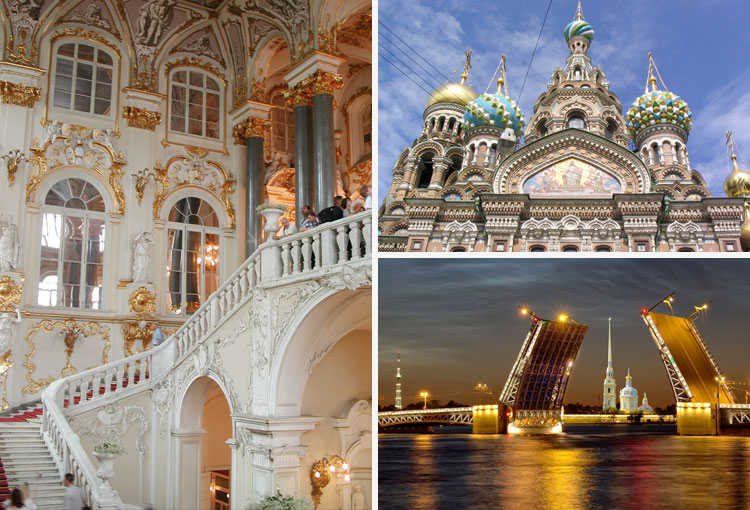
Санкт-Петербург – российский город-порт на Балтийском побережье. В течение двух столетий он оставался государственной столицей, основанной в 1703 г Петром Великим. Город все так же является культурным центром России, с его всемирно известными музеями, дворцами и театрами.
Эрмитаж – один из крупнейших и старейших музеев мира. Он был основан Екатериной Великой. Музей включает в себя шедевры Леонардо да Винчи, Пикассо, Ренуара, Винсента ван Гога, Рембрандта и других. Эксперты утверждают, что потребовалось бы целых 11 лет на изучение 3 миллионов экспонатов Эрмитажа.
Невский проспект – это главная улица Санкт-Петербурга, которая была прорублена сквозь густые леса в 1718 г. Казанский Собор с его впечатляющей колоннадой расположен в самом сердце улицы. Проспект застроен многочисленными кафе, ресторанами и магазинами.
Храм Спаса на Крови с его разноцветными куполами и яркой мозаикой был сооружен в начале 20 века на месте убийства царя Александра II в 1881 г. Используемая советскими властями для хранения картофеля во время 900-дневной блокады города нацистами во время Второй Мировой войны, храм был окончательно открыт для публики в 1997 г.
Петропавловская крепость – одно из первых зданий, возведенных в Санкт-Петербурге в 1703 г, включая Петропавловский собор в стиле барокко, ставший последним пристанищем почти для всех российских дореволюционных глав (Петра Великого, Екатерины Великой, Николая II и других). К другим достопримечательностям относятся впечатляющая статуя Петра Первого под названием «Медный всадник», действующий монетный двор и камеры, в которых держали революционеров.
Мариинский театр был впервые открыт в 1860 г. Долгое время театр является одним из наиболее выдающихся мест проведения балетных и оперных представлений. Его балетная школа выпустила таких всемирно известных балетных танцоров, как Рудольф Нуриев и Вацлав Нижинский.
В то время, как Государственный Эрмитаж представляет произведения изящного искусства со всего мира, Русский музей содержит отечественные шедевры. Открытый в 1898 г, музей представляет все: от бесценных православных икон до полотен таких знаменитых художников, как Суриков, Васнецов, Айвазовский, Кандинский. Среди выдающихся картин можно увидеть «Последний день Помпеи» Карла Брюллова и «Запорожские казаки пишут письмо турецкому султану» Ильи Репина.
Исаакиевский собор 19 века с его золотыми куполами – одна из известнейших визитных карточек Санкт-Петербурга. Он предлагает прекрасную панораму города со своей золоченой обзорной площадки. На крыше собора стоят на посту статуи апостолов, массивные двери украшены библейским сценами. Внутри собор может гордиться огромным расписным потолком, выполненным Брюлловым, а также Часовней Св.Катерины.
Васильевский остров – крупнейший остров в Санкт-Петербурге, предлагающий причудливую коллекцию достопримечательностей, включающих пару египетских сфинксов 15 века на побережье и музей биологических странностей «Кунсткамера», в котором можно увидеть скелет и сердце личного слуги-гиганта Петра Первого. На острове также стоят Ростральные колонны 19 века, чьи факелы зажигаются по особым случаям. Это отличное место для прогулок вдоль берегов реки Нева.
Презентация на тему: Санкт-Петербург, Исаакиевский собор
In 1816 Alexander I charged the young French architect Auguste Ricard Montferrand with designing the Cathedral.
The cathedral was being built for 40 years. Looking at it one can understand how much afford was made in order to carry out the architect’s plans. The Cathedral was being built on a swampy soil. Nearly 11 thousand piles and 120 granite columns were used to build it. The heaviest columns’ weigh was 144 tons. It took workers only 45 minutes to set the columns in their places.
In plan the Cathedral is an equilateral Greek cross with four porticos. It is faced with grey Karelia marble. There are a lot of big arch windows. On the top of the Cathedral there is a great golden dome. The Cathedral is 101 m high.
The diameter of outer dome is 25 m. 100 kg of pure gold was used for building the main dome.
On the porticos there are statues of 12 apostles. In the left side Peter the apostle hands the keys to the gate of Eden.
In the right side Paul the apostle hands a sword which is the symbol of his earnest service to Christ.
On the northern relief you can see resurrection of Christ and in the centre there is Christ risen from the dead. Beautifully made sculptures wonder.
The Cathedral is wonderful in any season.
Fill in the missing words: 1. In________ Alexander I charged the young architect with designing the cathedral. 2. It was being built for _____years. 3. It took workers ____minutes to set the column in its place. 4. The total height of the cathedral is _______meters. 5. ______kg of pure red gold was used for building the main dome. 6. On the porticos there are _____apostles. 7. Peter the apostle hands _________________________ 8. Paul the apostle hands _________________ 9. ________________________supervised the building of the cathedral and was its architect